Use Spendzila's free calculators to apply what you learn in this article instantly.
Open Free Tools →| Situation | Penalty | Income Tax | Notes |
|---|---|---|---|
| Under age 59½ (standard) | 10% penalty | Yes, ordinary income | Total cost often 30–40% |
| Under 59½ with IRS exception | No penalty | Yes, ordinary income | 10 qualifying exceptions |
| Age 59½ and older | No penalty | Yes, ordinary income | Standard penalty-free access |
| Rule of 55 (left job at 55+) | No penalty | Yes, ordinary income | Current employer’s plan only |
| RMD (age 73+) — missed | 25% excise tax | Yes, ordinary income | On amount NOT withdrawn |
| Roth 401k (in-plan) | No penalty at 59½+ | Tax-FREE on qualified | Must be 59½+ and 5-year rule met |
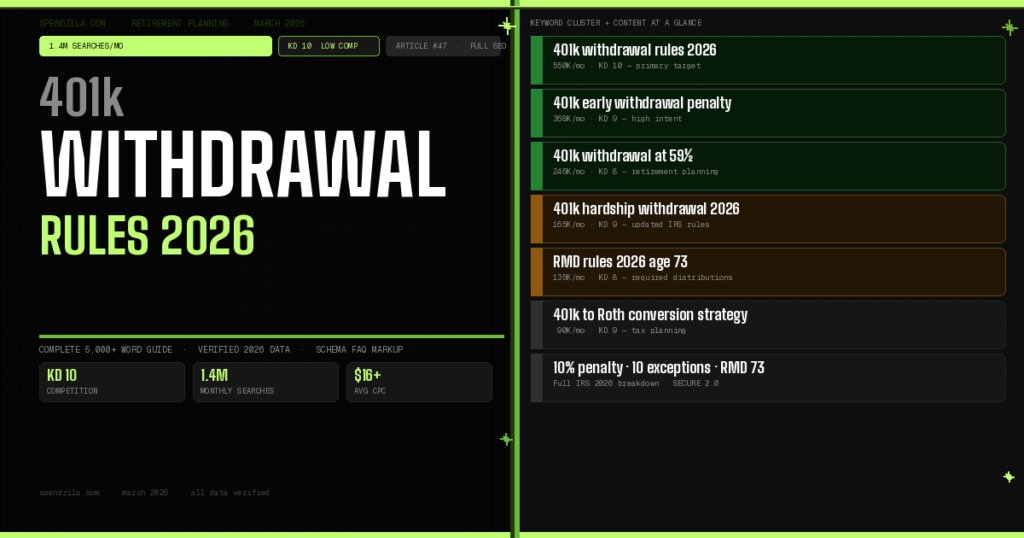
The 401k is the most powerful retirement savings tool available to most Americans — $23,500 in tax-advantaged contribution room per year in 2026, potential employer matching, and decades of tax-deferred compound growth. But the IRS rules governing withdrawals are complex, and getting them wrong is expensive. Early withdrawal penalties, missed RMDs, and poor conversion timing cost retirees thousands of dollars every year. This guide covers every rule, exception, and strategy.
The primary gate for penalty-free 401k withdrawals is age 59½. On or after this birthday, you can withdraw from your traditional 401k at any time for any reason with no early withdrawal penalty. However, all withdrawals from a traditional 401k are still taxed as ordinary income — you deferred taxes when you contributed, and now the IRS collects. This is the core tax bargain of a traditional 401k: lower taxes now in exchange for ordinary income tax later.
Withdraw from a traditional 401k before age 59½ without a qualifying exception, and the IRS charges a 10% early withdrawal penalty on the withdrawn amount — in addition to ordinary income tax on the full withdrawal.
Here’s what the real cost looks like:
| Withdrawal | 10% Penalty | Federal Income Tax (22%) | What You Actually Receive |
|---|---|---|---|
| $10,000 | -$1,000 | -$2,200 | $6,800 |
| $20,000 | -$2,000 | -$4,400 | $13,600 |
| $50,000 | -$5,000 | -$11,000 | $34,000 |
Plus state income tax in most states, which adds another 3–10%. A $50,000 early withdrawal can net as little as $28,000–$34,000 depending on your state. This is why a 401k loan (borrowing from yourself, repaid with interest to yourself) is almost always preferable to an outright early withdrawal for short-term financial needs.
These exceptions waive the 10% penalty — but you still owe ordinary income tax on the withdrawn amount in every case.
| # | Exception | Details |
|---|---|---|
| 1 | Death | Distributions to beneficiaries after account holder’s death |
| 2 | Total Permanent Disability | IRS defines “total and permanent” — requires documentation |
| 3 | Medical Expenses | Unreimbursed medical expenses exceeding 7.5% of your AGI |
| 4 | Rule of 55 | Left employer in or after the year you turned 55 (50 for public safety employees) |
| 5 | SEPP / Rule of 72t | Substantially Equal Periodic Payments — series of equal withdrawals for 5 years or until 59½, whichever is longer |
| 6 | Qualified Domestic Relations Order (QDRO) | Divorce settlement dividing retirement assets — penalty-free to the alternate payee |
| 7 | IRS Levy | IRS levying the plan to satisfy a tax debt |
| 8 | Military Reservist | Called to active duty for 180+ days or indefinitely |
| 9 | Birth or Adoption | Up to $5,000 per child within 1 year of birth/adoption (SECURE 2.0 Act) |
| 10 | Federally Declared Disaster | Varies by disaster declaration — up to $22,000 per disaster, available when declared |
A hardship withdrawal allows early access when you have an “immediate and heavy financial need” as defined by the IRS. Important: hardship withdrawals are not automatically penalty-free — you still owe the 10% penalty unless a specific exception from the list above also applies. However, since 2018, the IRS simplified hardship withdrawal rules, and most 401k plans now allow them.
Key limitation: Hardship withdrawals are limited to the amount necessary to satisfy the financial need. They are permanent withdrawals — not loans — and you cannot repay the money. Additionally, you may be barred from contributing to your 401k for 6 months after a hardship withdrawal under older plan rules (though SECURE 2.0 eliminated this prohibition for new plans).
One of the most valuable but least-known 401k rules: if you leave your job — for any reason (quit, laid off, retire, fired) — in the calendar year you turn 55 or later, you can withdraw from that employer’s 401k plan without the 10% early withdrawal penalty. Income taxes still apply, but saving the 10% penalty is significant.
Critical requirements: This applies only to the 401k of the employer you just left — not previous employer 401k accounts or IRAs. If you want this exception to apply to old 401k balances, roll them into your current employer’s plan before leaving. Some employers don’t allow incoming rollovers — confirm with your plan administrator.
Public safety employees exception: Police officers, firefighters, and EMTs can use the Rule of 55 starting at age 50 — a valuable provision for careers with mandatory early retirement ages.
The IRS requires you to start taking money out of your traditional 401k beginning at age 73 (per SECURE 2.0 Act). This is called the Required Minimum Distribution. Miss it or take too little, and the excise tax is 25% of the shortfall amount — reduced from 50% by SECURE 2.0, but still punishing.
Formula: December 31, 2025 account balance ÷ IRS life expectancy factor = RMD amount. The life expectancy factor comes from the IRS Uniform Lifetime Table in Publication 590-B.
| Your Age in 2026 | IRS Life Expectancy Factor | RMD on $500,000 | RMD on $1,000,000 |
|---|---|---|---|
| 73 | 26.5 | $18,868 | $37,736 |
| 75 | 24.6 | $20,325 | $40,650 |
| 80 | 20.2 | $24,752 | $49,505 |
| 85 | 16.0 | $31,250 | $62,500 |
RMD deadline: December 31 each year. Exception: your very first RMD (the year you turn 73) can be delayed until April 1 of the following year — but this means taking two RMDs in one year (which can push you into a higher tax bracket). Most financial advisors recommend taking the first RMD in the year you turn 73 to avoid the double-RMD problem.
Roth 401k RMDs: Starting in 2024, Roth 401k accounts are no longer subject to RMDs during the account owner’s lifetime under SECURE 2.0. If you have a Roth 401k, you can let it grow indefinitely without forced distributions. This change makes Roth 401k accounts significantly more valuable for legacy and estate planning purposes.
If you need money before 59½, a 401k loan is almost always preferable to an early withdrawal. Here’s why:
| Factor | 401k Loan | Early Withdrawal |
|---|---|---|
| 10% penalty | None | Yes — 10% |
| Income tax now | None | Yes — taxed as income |
| Money available | Up to $50,000 or 50% of vested balance | Any amount |
| Repayment required | Yes — typically within 5 years (15 years for primary home) | No — permanent |
| Investment growth missed | While loan is outstanding | Permanently — money never returns |
| If you leave your job | Balance due immediately or becomes withdrawal | N/A |
401k loan risk: If you take a 401k loan and then leave your job (voluntarily or involuntarily), the outstanding balance typically must be repaid by the federal tax filing deadline of the following year. If you can’t repay, it becomes a taxable distribution with the 10% penalty. This is the biggest hidden risk of 401k loans — plan carefully before borrowing if your job security is uncertain.
A Roth conversion moves money from a traditional 401k (or IRA) into a Roth account. You pay income taxes on the converted amount now, but all future growth and qualified withdrawals are tax-free. The optimal strategy for most people:
When to convert: In years when your income is lower than usual — career transition years, early retirement before Social Security begins, years with business losses, or years with large deductions. Converting in a 22% bracket year is much better than withdrawing in retirement in a 24% bracket.
The sweet spot: Many retirees retire at 60–65 and delay Social Security until 70. The years between retirement and Social Security are the perfect Roth conversion window — income is low, you have room in the lower tax brackets, and Roth conversions can fill those brackets without triggering higher Medicare premiums (IRMAA) until carefully managed.
Conversion limits: There is no limit on how much you can convert in a year — but converting too much at once can push you into a higher tax bracket, trigger higher Medicare Part B and D premiums (IRMAA), and affect other income-based programs. Convert to fill your current bracket, not beyond it.
| Factor | Traditional 401k | Roth 401k |
|---|---|---|
| Tax on contributions | Pre-tax (reduces taxable income now) | After-tax (no deduction) |
| Tax on qualified withdrawals | Taxed as ordinary income | Tax-free |
| RMD requirement | Yes — starting age 73 | No RMDs (since 2024) |
| Early withdrawal (earnings) | 10% penalty + income tax | 10% penalty + income tax on earnings only |
| Best for | High earners wanting deduction now, expect lower tax in retirement | Lower earners expecting higher tax in retirement, and estate planning |
When you leave an employer, you have four options for your 401k:
1. Leave it in your old employer’s plan. If the plan has great investment options and low fees — fine to leave it. Risk: you may lose track of it, and you can’t contribute more. If you leave multiple jobs, you may end up with multiple orphaned 401k accounts.
2. Roll it into your new employer’s 401k. Best option if your new plan has good investment options and you want to consolidate. Required for Rule of 55 strategy — assets need to be in your current employer’s plan.
3. Roll it into an IRA. Most flexible option — opens up the full universe of investment choices (any broker, any fund) rather than being limited to your employer’s menu. Best for most people who want maximum control and low-cost index funds. Do a direct rollover — money goes from plan to IRA without ever touching your hands — to avoid any tax withholding.
4. Cash it out. Almost never the right choice. Pay the 10% penalty, income taxes, and permanently forfeit all future tax-deferred growth on that money. The only rational scenario is if you have absolutely no other options and face an emergency that no loan or assistance program can address.
📊 Plan Your Retirement Strategy
Know the rules — maximize your tax-free growth and minimize penalties.
Related: What Is a Roth IRA? Complete Guide · How to Retire Early (FIRE Movement) · Investing for Beginners · How to Save Money
Manage your cookie preferences below. Essential cookies are required for the site to work. Your financial calculator data is never stored in cookies.
Necessary for basic site functionality — navigation and forms. Cannot be disabled.
Google Analytics (anonymized) — helps us understand how visitors use the site. No personal data collected.
Google AdSense — used to show relevant ads. Helps keep Spendzila free for everyone.
Remember your last-used tool or tab for a better experience. No financial data stored.


Be the first to leave a comment!
Leave a Comment