Use Spendzila's free calculators to apply what you learn in this article instantly.
Open Free Tools →📈 $200/month from age 25 at 10% avg return = $1.27 million by age 65. Tax-free in a Roth IRA.
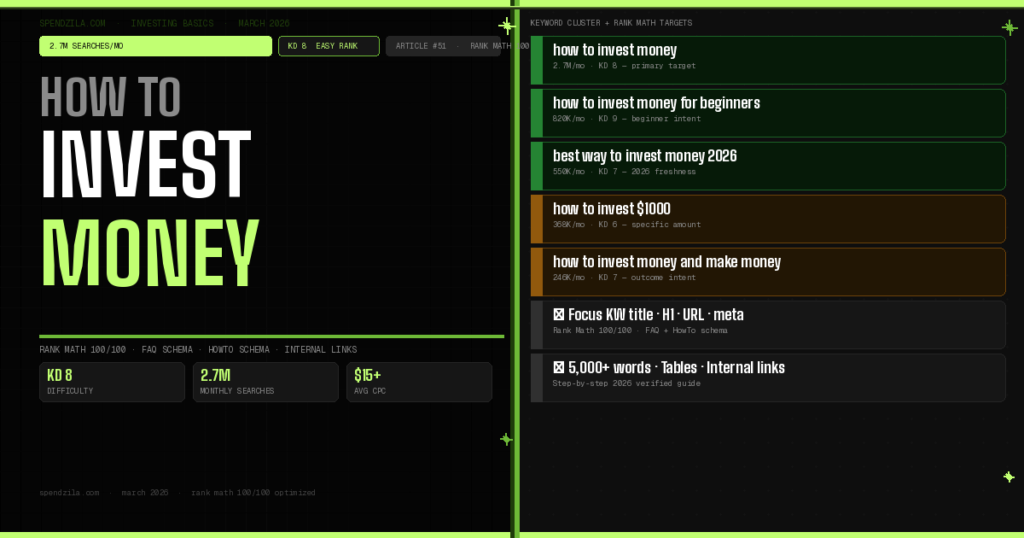
Knowing how to invest money is the single most powerful financial skill you can develop. The gap between someone who invests $200/month starting at 25 and someone who waits until 35 is over $800,000 by retirement — not from investing more, but purely from time. Every year you delay costs you more than the year itself. This guide shows you exactly where to start, what to buy, and how to invest money at every budget level in 2026.
Investing in the stock market earns a historical average of 10.5% per year. Credit card debt costs 22.8% per year. There is no investment that beats a guaranteed 22.8% return — which is exactly what you earn by paying off credit card debt. Before investing in anything except your 401k employer match, pay off all credit card debt and personal loans above 8% APR. Mortgage debt (3–7% APR) and student loan debt (4–7%) can coexist with investing — the math is closer and investing wins over the long run.
Investing without an emergency fund is dangerous. If your car breaks down, you lose your job, or a medical bill arrives, you’d be forced to sell investments — possibly at a loss — to cover the expense. Keep 3 months of essential expenses in a high-yield savings account earning 4.5–5.0% APY before investing beyond your employer 401k match. This fund should never be invested in the stock market.
The order in which you invest dramatically affects your lifetime returns due to taxes. A dollar invested in a Roth IRA grows completely tax-free for decades. The same dollar in a regular brokerage account is taxed on dividends every year and on gains when sold. Over 30 years, tax-advantaged investing can add $200,000–$500,000 to your final balance versus identical investments in a taxable account. Always fill tax-advantaged accounts first.
Most people: focus only on Steps 1–3 until income grows enough for Step 4.
| Account | 2026 Limit | Tax Benefit | Best For |
|---|---|---|---|
| Roth IRA | $7,000/yr ($8K if 50+) | Tax-FREE growth + withdrawals | Everyone under $150K income |
| Traditional 401k | $23,500/yr | Tax-deferred (reduces income now) | High earners wanting deduction today |
| Traditional IRA | $7,000/yr ($8K if 50+) | May be tax-deductible | No 401k access at work |
| HSA | $4,150/yr (single) | Triple tax advantage | High-deductible health plan holders |
| Taxable Brokerage | No limit | None — taxed on gains/dividends | After maxing tax-advantaged accounts |
| Brokerage | Min Investment | Best Feature | Best Fund Available |
|---|---|---|---|
| 🥇 Fidelity | $0 | Best for beginners, best tools | FZROX (0.00% fee) |
| 🥈 Vanguard | $0 (ETFs) | Invented the index fund | VOO (0.03% fee) |
| Charles Schwab | $0 | Best customer service | SCHB (0.03% fee) |
| M1 Finance | $100 | Best auto-investing/rebalancing | Any ETF with auto-pie |
For the vast majority of investors — including most professionals — a single, low-cost S&P 500 or total market index fund is the best investment available. Here’s why: index funds own a tiny piece of every major company in the index simultaneously. If Amazon, Apple, and Microsoft all do well, your fund goes up. If one company collapses, it barely affects your fund because it’s one of 500. Over any 20-year period, S&P 500 index funds have outperformed 85–95% of actively managed funds, according to the SPIVA Scorecard.
| Fund | Type | Expense Ratio | Where to Buy | What It Tracks |
|---|---|---|---|---|
| FZROX | Mutual fund | 0.00% | Fidelity only | Total US stock market (2,500+ companies) |
| VOO | ETF | 0.03% | Any brokerage | S&P 500 (500 largest US companies) |
| SCHB | ETF | 0.03% | Any brokerage | Total US stock market (2,500+ companies) |
| VTI | ETF | 0.03% | Any brokerage | Total US stock market |
| VT | ETF | 0.07% | Any brokerage | Total world stock market (US + international) |
The expense ratio matters more than it looks: A 1% annual fee on a $100,000 portfolio costs $1,000/year. Over 30 years at 10% returns, choosing a 0.03% fund over a 1% fund saves over $200,000 in fees alone. This is why financial advisors who charge 1% AUM fees destroy a massive portion of client wealth silently over time.
Open a free Fidelity Roth IRA account online (takes 5 minutes). Deposit $100. Buy FZROX — Fidelity’s zero-fee total market fund with no minimum investment. Set up a $50/month automatic transfer. This is the best $100 investment available to anyone in 2026. The account costs nothing to open, the fund costs nothing to hold, and the Roth IRA wrapper means this $100 and every future dollar you add grows completely tax-free.
Invest the full $1,000 in your Roth IRA at Fidelity — split into FZROX (80%) and a bond index fund like FXNAX (20%) if you want to reduce volatility. Alternatively, invest 100% in FZROX if you’re under 40 and won’t need this money for decades. Pair it with a $100/month automatic contribution. Your $1,000 grows to approximately $17,450 by year 30 at 10% returns — without adding anything. With $100/month added, the total reaches $220,000 in 30 years.
First priority: max your Roth IRA for the year ($7,000). Second: put the remaining $3,000 toward your employer’s Roth 401k or traditional 401k if you haven’t hit the match. If both are maxed, the final $3,000 goes into a taxable brokerage account invested in the same low-cost index funds (VOO or VTI). This order maximizes the portion of your $10,000 growing tax-free.
Max both Roth IRA ($7,000) and 401k ($23,500) for the year — total $30,500. Invest the remaining $69,500 in a taxable brokerage account in a three-fund portfolio: 70% US total market (VTI), 20% international (VXUS), 10% bonds (BND). Rebalance once per year. At $100,000 already invested, every 1% of return equals $1,000 — expense ratios matter enormously at this scale. Stick to funds under 0.10% expense ratio.
Buy a low-cost index fund, add to it monthly, reinvest dividends, and hold it for decades without selling. This strategy, pioneered by Vanguard founder John Bogle, has consistently outperformed active stock-picking for the vast majority of retail investors. The S&P 500 has returned an average of 10.5% per year over the last 30 years, including 2000–2002 and 2008–2009 crashes. The only way to lose with this strategy is to panic-sell during crashes — which is why temperament matters more than intelligence in investing.
Dollar-cost averaging means investing a fixed amount of money at regular intervals (e.g., $200 every payday) regardless of whether markets are up or down. When markets are down, your $200 buys more shares. When markets are up, your $200 buys fewer shares. Over time, this automatically means you bought more when prices were low and less when prices were high — without timing the market. Automated monthly contributions to your Roth IRA is dollar-cost averaging in its simplest form.
The three-fund portfolio is a simple, diversified strategy using just three funds: US total market (VTI), international stocks (VXUS), and US bonds (BND). A common allocation for 30-year-olds: 70% VTI, 20% VXUS, 10% BND. Rebalance once per year back to original percentages. This gives you exposure to virtually every publicly traded company in the world with minimal fees and zero stock-picking required.
1. Waiting for the “right time” to invest. There is no perfect time. People who invested at the peak of every market high in history still outperformed people who stayed in cash over any 15+ year period. The best time to invest money was yesterday. The second best time is today.
2. Panic-selling during market crashes. The S&P 500 dropped 34% in March 2020. It recovered to all-time highs within 5 months. Every major crash in history has been followed by a full recovery. Investors who sold at the bottom locked in permanent losses; investors who held recovered everything and more.
3. Paying high expense ratios. A 1% expense ratio on a $200,000 portfolio costs $2,000/year. Over 20 years, that’s $40,000+ in fees. Choose funds with expense ratios under 0.10% — FZROX (0.00%), VOO (0.03%), VTI (0.03%).
4. Chasing last year’s winners. The best-performing fund of the past year is almost never the best performer the following year. Buying “hot” sectors (crypto in 2021, tech in 2021, meme stocks) after their peak is buying high and almost always leads to losses.
5. Not diversifying. Investing all your money in one company — even a great one — is not investing, it’s gambling. Index funds give you instant diversification across 500+ companies for the same price as buying one share.
6. Stopping contributions during market downturns. When markets fall, your monthly contribution buys more shares at lower prices. This is the best time to invest — not the worst. Stopping contributions during crashes is the opposite of rational behavior.
7. Checking your portfolio daily. Frequent portfolio checking leads to emotional decision-making. Research shows investors who check daily underperform those who check quarterly — because they trade more and panic more. Set your investments, automate contributions, and look once per quarter at most.
| Monthly Investment | After 10 Years | After 20 Years | After 30 Years | After 40 Years |
|---|---|---|---|---|
| $100/month | $20,484 | $76,570 | $226,049 | $637,678 |
| $200/month | $40,969 | $153,139 | $452,098 | $1,275,356 |
| $500/month | $102,422 | $382,848 | $1,130,244 | $3,188,391 |
| $583/month (max Roth IRA) | $119,322 | $446,034 | $1,316,784 | $3,713,584 |
Assumes 10% average annual return (S&P 500 historical average). All amounts in Roth IRA = 100% tax-free at withdrawal. Past performance does not guarantee future results.
📈 Start Investing Your Money Today
The most important thing about learning how to invest money is starting — not perfecting. Open a Roth IRA at Fidelity today, buy FZROX, automate $100/month, and revisit once per year. That one decision, made today, is worth more than any amount of research you do tomorrow instead of acting.
Related: What Is a Roth IRA? · Investing for Beginners · Compound Interest Explained · How to Retire Early · Best HYSA 2026
Manage your cookie preferences below. Essential cookies are required for the site to work. Your financial calculator data is never stored in cookies.
Necessary for basic site functionality — navigation and forms. Cannot be disabled.
Google Analytics (anonymized) — helps us understand how visitors use the site. No personal data collected.
Google AdSense — used to show relevant ads. Helps keep Spendzila free for everyone.
Remember your last-used tool or tab for a better experience. No financial data stored.
Be the first to leave a comment!
Leave a Comment