Use Spendzila's free calculators to apply what you learn in this article instantly.
Open Free Tools →| Stat | Reality |
|---|---|
| % of people who negotiate | Only 37% negotiate job offers |
| % who get more when they ask | 85% receive a higher offer |
| Average raise from negotiating vs not | $5,000–$20,000 more per year |
| Lifetime earnings impact of one negotiation | $500,000–$1,000,000+ |
| % of managers who withdrew offer after negotiation | Less than 2% |
Salary negotiation is the highest-ROI financial skill you can develop. A single successful negotiation that adds $10,000/year to your base salary compounds into $500,000+ in additional lifetime earnings — because every future raise, bonus, and retirement contribution is calculated as a percentage of that higher base. And it takes one 10-minute conversation.
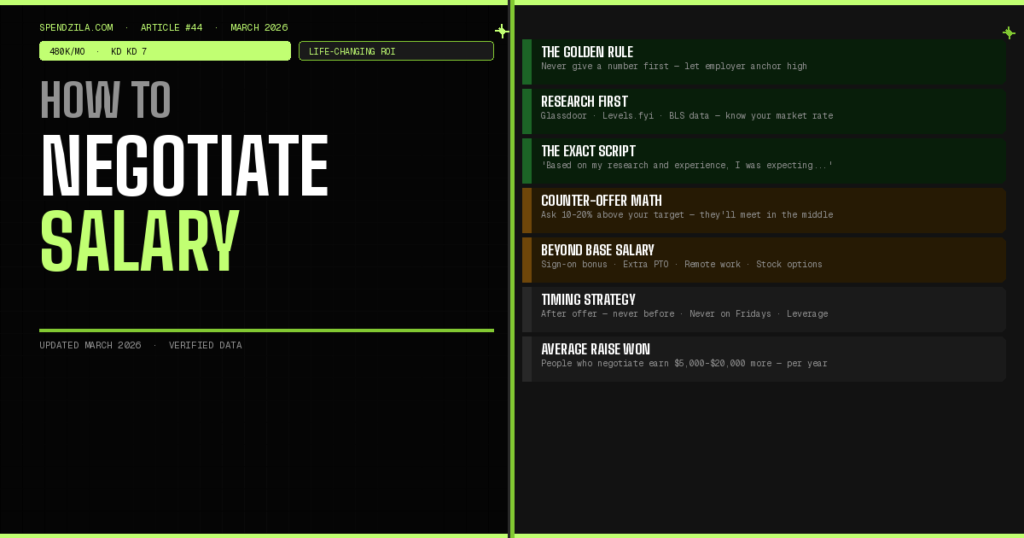
Never walk into a negotiation without data. Check at least 3 sources: Glassdoor.com (self-reported salaries by company and role), Levels.fyi (total compensation for tech roles), LinkedIn Salary (role + location data), Bureau of Labor Statistics (government data for any occupation), and Payscale.com. Know your number before the conversation. Presenting a specific number with a source is 3x more persuasive than a vague range.
The first number in any negotiation sets the psychological anchor. If they ask for your expected salary before making an offer, say: “I’d prefer to understand the full scope of the role first — what is the budgeted range for this position?” Or: “I’m flexible based on the total compensation package. What range have you budgeted?”. Getting them to anchor first almost always results in a higher final number than if you anchor first.
“Thank you so much for the offer — I’m genuinely excited about this role and the team.
I’ve done some research on the market rate for this position in [city],
and based on my [X years] of experience in [specific skill],
I was expecting something closer to $78,000–$80,000.
Is there flexibility to get closer to that range?”
Then — stay silent. Do not fill the silence.
If the employer says the salary is fixed, negotiate: Signing bonus (one-time, easier for employers to approve than base increases), Extra PTO (one week of extra vacation is worth $1,200–$2,500 at most salaries), Remote work flexibility (commute elimination worth $3,000–$8,000/year in gas, car wear, and time), Earlier performance review (ask for a 6-month review instead of 12 with a commitment to revisit salary), and Professional development budget ($1,000–$5,000/year for courses, certifications, or conferences).
Timing: After a major win, during performance review season, or after taking on significant new responsibilities. Not during company-wide budget freezes or layoffs. Preparation: Write down 3–5 specific accomplishments with quantified impact from the past 6–12 months. “I led the project that increased X by 23%” is compelling. “I’ve been working hard” is not. Ask: Request 8–15% above current salary. Justify with your market research and your documented contributions.
💰 Earn More — Then Invest the Difference
Related: Side Hustle Ideas 2026 · Build a Budget · Start Investing
Manage your cookie preferences below. Essential cookies are required for the site to work. Your financial calculator data is never stored in cookies.
Necessary for basic site functionality — navigation and forms. Cannot be disabled.
Google Analytics (anonymized) — helps us understand how visitors use the site. No personal data collected.
Google AdSense — used to show relevant ads. Helps keep Spendzila free for everyone.
Remember your last-used tool or tab for a better experience. No financial data stored.


Be the first to leave a comment!
Leave a Comment