Use Spendzila's free calculators to apply what you learn in this article instantly.
Open Free Tools →| Debt Type | Average Balance | Average APR | Priority to Pay Off |
|---|---|---|---|
| Credit Cards | $10,479 | 22.8% | 🎯 FIRST — attack immediately |
| Personal Loans | $11,548 | 12.4% | SECOND — if above 8% APR |
| Auto Loans | $23,792 | 7.1% | THIRD — borderline invest vs pay |
| Student Loans | $38,290 | 5.5% avg | Pay minimum, invest alongside |
| Mortgage | $244,498 | 6.2% avg | Pay minimum, invest the rest |
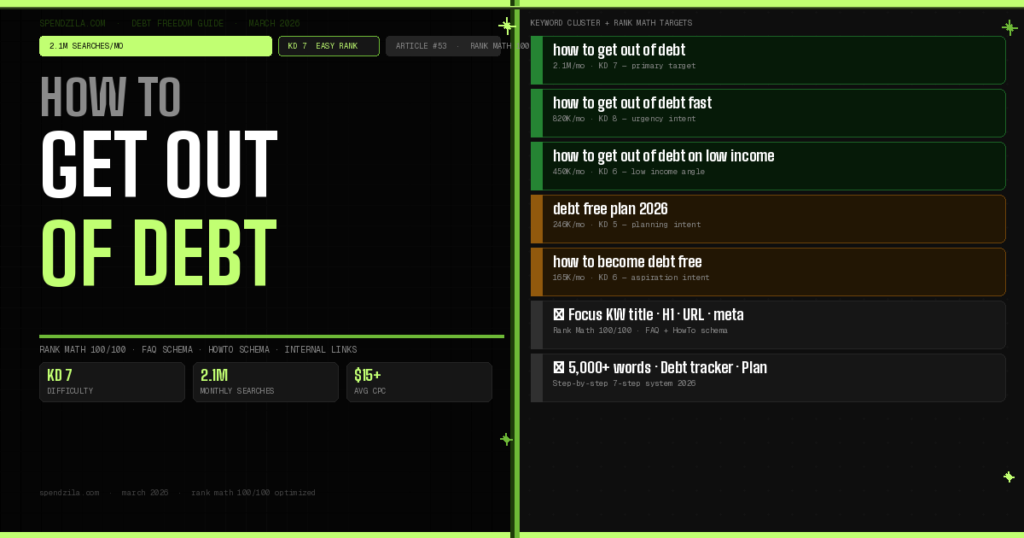
Americans collectively owe $17.5 trillion in total household debt as of Q4 2025. The average household carries debt across 3–4 categories simultaneously. Knowing how to get out of debt requires more than willpower — it requires a systematic approach that addresses the math, the behavior, and the psychology simultaneously. This 7-step plan has helped millions of Americans eliminate debt at every income level.
The debt crisis in America is not primarily about large numbers — it’s about interest rates. A $10,000 student loan at 5.5% is a manageable problem. A $10,000 credit card balance at 22.8% is financially devastating — it compounds $2,280 in interest per year and is specifically designed through minimum payment structures to keep you paying for decades. The priority of any debt elimination plan is clear: attack high-interest debt first, keep low-interest debt for last.
You cannot defeat an enemy you don’t fully see. Most people who complete this step are surprised — the total is almost always higher than their mental estimate. Pull out paper or a spreadsheet and write every debt you owe:
| Creditor | Total Balance | APR | Minimum Payment | Monthly Interest Cost |
|---|---|---|---|---|
| Chase Visa | $___ | ___% | $___ | $___ |
| Capital One Card | $___ | ___% | $___ | $___ |
| Car Loan | $___ | ___% | $___ | $___ |
| Student Loans | $___ | ___% | $___ | $___ |
| TOTAL | $___ | — | $___/mo | $___/mo |
The monthly interest cost column is often the most revealing. When you see “$390/month” in interest charges — money that buys you nothing, reduces no principal, and just evaporates — it creates powerful motivation to attack the debt urgently.
You cannot fill a bucket while the faucet is running. If you add $200 in new charges to a card while paying $300 toward it, you’re effectively only reducing the balance by $100/month — even though your payment was $300. The first step of getting out of debt is a complete spending freeze on credit: no new credit card charges, no new loans, no buy-now-pay-later. Switch to debit card or cash for all daily spending. If an emergency arises, use your $1,000 emergency buffer (Step 3) before touching credit.
Practical method: Freeze your credit cards — literally. Place them in a container of water and put them in the freezer. The inconvenience of waiting for them to thaw adds enough friction to eliminate impulse purchases. If that’s too dramatic, simply remove all saved card information from every shopping website and app. Studies show removing one-click purchasing reduces impulse spending by 40–60%.
Before aggressively paying down debt, build a $1,000 cash buffer in a separate savings account. This mini-emergency fund exists for one purpose: preventing a flat tire, medical copay, or home repair from sending new charges onto the credit card you’re working to eliminate. Without this buffer, the cycle repeats endlessly. $1,000 covers 78% of all common financial emergencies, according to financial planning research. Build this before making extra debt payments — it can usually be accumulated within 30–60 days through a combination of subscription cancellations and selling unused items.
A zero-based budget assigns every dollar of your monthly income to a specific category before the month begins, so that income minus all assignments = $0. This doesn’t mean spending everything — it means intentionally assigning surplus dollars to debt payoff. The process: (1) Write your total monthly take-home income. (2) Subtract fixed necessities: rent, utilities, insurance, minimum debt payments, groceries. (3) Cut every non-essential category to the bone while you’re in debt-attack mode. (4) Assign every remaining dollar to your target debt. Use YNAB or Empower to make this automatic and visible.
Pay the minimum on every debt. Apply every extra dollar to the debt with the highest APR. When that debt is eliminated, redirect its entire payment to the next highest APR. Continue until debt-free. This method saves the maximum amount of money in interest — typically $1,000–$5,000 more than the snowball on a $20,000+ debt load. Best for: people motivated by numbers and math, who can maintain discipline through slow early progress.
Pay the minimum on every debt. Apply every extra dollar to the smallest balance. When the smallest balance is eliminated, redirect its entire payment to the next smallest. This creates faster psychological wins — eliminating an account entirely provides a dopamine reward that keeps people motivated. Research by Harvard Business Review found higher debt-free completion rates for snowball users. Best for: people who need visible wins to stay motivated over a 1–3 year payoff journey.
| Factor | Choose Avalanche | Choose Snowball |
|---|---|---|
| Motivation style | Data-driven, patient | Needs wins to keep going |
| APR differences | Large spread (10%+ gap) | Similar APRs across debts |
| Total interest savings | Higher (optimal) | Slightly less |
| Completion rate | High (for data people) | Higher (for most people) |
The speed of your debt payoff is directly proportional to how much extra money you can apply monthly. Every $100/month extra you find accelerates your payoff by 6–12 months on a $15,000 debt load. Here are the fastest sources of extra debt-attack money:
Cut immediately (same day): Cancel unused streaming subscriptions ($10–$60/month), cancel gym memberships you don’t use ($20–$60/month), pause unused software subscriptions ($10–$50/month). Total potential: $50–$200/month with 30 minutes of cancellations.
Reduce spending: Meal prep instead of eating out ($150–$400/month savings), switch to store-brand groceries ($40–$100/month), cancel cable ($60–$150/month), switch to a cheaper phone plan ($30–$60/month).
Earn more: Sell unused items on Facebook Marketplace ($200–$500 lump sum), pick up DoorDash/Uber Eats shifts ($200–$400/weekend), complete UserTesting sessions ($50–$150/month), offer a service on Fiverr or Upwork.
Windfall rule: Apply 100% of unexpected money directly to your target debt before spending any of it — tax refunds (average $3,011 in 2025), work bonuses, cash gifts, and insurance settlements. This single rule can cut 6–18 months from most debt payoff timelines.
This step is underutilized and highly effective. Call the number on the back of each credit card and say: “I’ve been a customer for X years with a good payment history. I’m focused on paying down my balance and I’d like to request a lower interest rate.” According to a 2023 LendingTree survey, 69% of people who ask receive a rate reduction, with an average reduction of 4–6 percentage points. On a $8,000 balance, a 5% APR reduction saves $400/year — for a 10-minute phone call. Do this for every card, every year.
If refused: Ask to speak with the retention department specifically. Ask what your account would need to look like to qualify for a lower rate. Make a note to call back in 6 months.
Getting out of debt on a low income is harder, but the same principles apply with greater intensity. The key differences:
Apply for every assistance program available. SNAP food assistance, LIHEAP utility assistance, Medicaid health coverage, and local food banks can free up $200–$600/month that previously went to food, utilities, and healthcare — money that can now attack debt. Many people leave significant assistance unclaimed because they don’t apply.
Focus on income increase first. On a $25,000 income, cutting expenses has a ceiling — you can only cut so much from an already-thin budget. Adding $300–$500/month of side income via DoorDash or freelancing is often more impactful than cutting spending when income is already minimal.
Nonprofit credit counseling. NFCC (National Foundation for Credit Counseling) member agencies offer free or low-cost debt management plans that negotiate reduced interest rates with creditors on your behalf — often achieving rates of 6–9% even on cards currently at 22%+. For people overwhelmed by multiple debts, this can be more effective than the DIY approach.
Bankruptcy as a last resort. Chapter 7 bankruptcy discharges most unsecured debt (credit cards, personal loans, medical bills) within 3–6 months but remains on your credit report for 10 years. It’s not a failure — it’s a legal tool designed specifically for financial hardship. If your debt-to-income ratio makes repayment mathematically impossible (debt more than 2–3x your annual income with no path to higher income), consult a bankruptcy attorney. Many offer free initial consultations.
WEEK 2 — BUILD YOUR SYSTEM
☐ Create a zero-based budget (YNAB free trial or spreadsheet)
☐ Choose your strategy: avalanche or snowball
☐ Set up autopay minimums on ALL debts (protect credit score)
☐ Call each credit card — request lower APR (10 minutes each)
MONTH 2 — ATTACK
☐ $1,000 emergency buffer complete
☐ Apply for balance transfer card if credit score 670+ (21 months 0%)
☐ Sell $200–$500 in unused items — apply 100% to target debt
☐ First extra payment hits target debt — track progress visibly
MONTH 3 — MOMENTUM
☐ Review progress — calculate months saved by extra payments
☐ Add one side income source (delivery, freelance, Etsy)
☐ Apply March tax refund (if received) 100% to debt
☐ Calculate your debt-free date — write it somewhere visible
Knowing how to get out of debt is ultimately about deciding that your future financial freedom is worth temporary sacrifice. Every dollar you don’t spend on a want today is a dollar that eliminates interest tomorrow. The people who become debt-free aren’t people with more income — they’re people who made the decision and executed a system consistently. Use this 7-step plan, adapt it to your situation, and commit to your debt-free date.
🎯 Debt-Free → Build Wealth
Related: Pay Off Credit Card Debt · Snowball vs Avalanche Guide · How to Save Money Fast · Best Budgeting Apps · Build an Emergency Fund
Manage your cookie preferences below. Essential cookies are required for the site to work. Your financial calculator data is never stored in cookies.
Necessary for basic site functionality — navigation and forms. Cannot be disabled.
Google Analytics (anonymized) — helps us understand how visitors use the site. No personal data collected.
Google AdSense — used to show relevant ads. Helps keep Spendzila free for everyone.
Remember your last-used tool or tab for a better experience. No financial data stored.

Be the first to leave a comment!
Leave a Comment