Use Spendzila's free calculators to apply what you learn in this article instantly.
Open Free Tools →Full guide with card comparisons, approval tips, and credit-building strategy below. Updated March 2026.
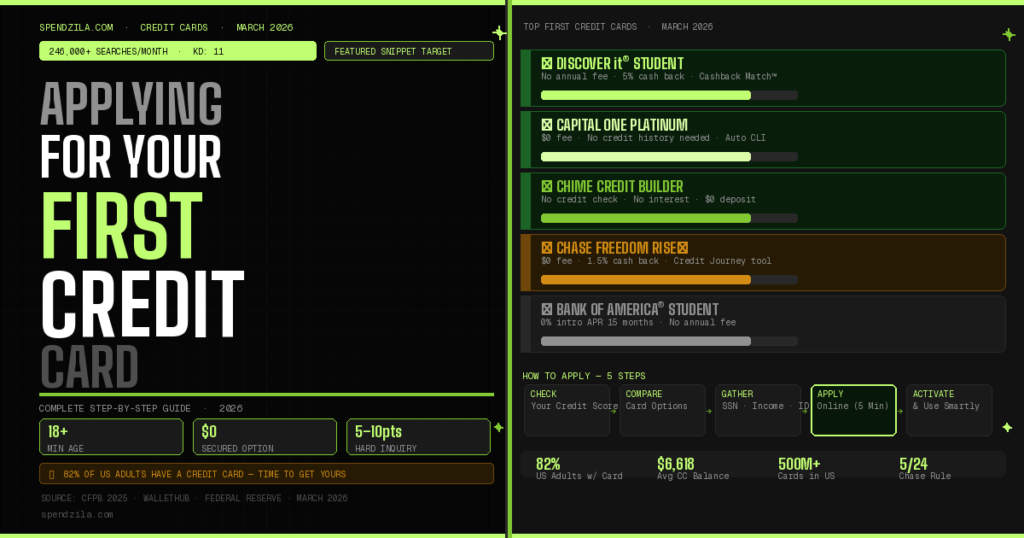
82% of American adults now have at least one credit card — and if you’re reading this, you’re ready to join them. Getting your first credit card is one of the most important financial moves you can make in your 20s. Done right, it costs you nothing, earns you rewards, and builds the credit score that will determine your mortgage rate, your apartment application, and even some job offers for decades to come.
This complete guide covers everything about applying for your first credit card in 2026 — who qualifies, which card to choose, exactly how to apply step by step, and how to use it to build your credit score as fast as possible. All data is verified from the CFPB 2025 Consumer Credit Card Market Report, WalletHub, and official issuer terms.
There is a common misconception that credit cards are dangerous and should be avoided. The reality, backed by data: Americans with credit cards and strong credit scores pay hundreds of thousands of dollars less over their lifetimes in interest rates on mortgages, car loans, and personal loans — compared to people with no credit or poor credit.
| Credit Score Tier | 30-Year Mortgage Rate | Monthly Payment ($400K) | Total Lifetime Cost |
|---|---|---|---|
| Exceptional (760+) | ~6.0% | $2,398 | $863,353 |
| Good (715 avg) | ~6.8% | $2,609 | $939,352 |
| Poor / No Credit | ~8.5%+ | $3,076 | $1,107,417 |
The difference between excellent credit and poor credit on a single mortgage: $244,064. That’s the price of having no credit history. Getting your first credit card today — and using it responsibly — is the first step to avoiding that penalty.
Beyond mortgages, your credit score affects:
Here is exactly what you need to qualify for your first credit card:
| Requirement | Details | Workaround If You Don’t Qualify |
|---|---|---|
| Age: 18+ | Must be 18 or older in the US | Under 18: become an authorized user on a parent’s card |
| SSN or ITIN | Social Security Number required by most issuers | No SSN: use ITIN, or try NOVA Credit for immigrants |
| Income | Must show ability to pay; includes part-time work, scholarships | Under 21 with no income: need a cosigner or secured card |
| Credit Score | Not required for starter cards — no history is fine | No score: apply for secured cards or student cards |
| US Address | A valid US mailing address | Non-US citizens: use ITIN + US address (work visa holders qualify) |
| Card Type | Best For | Deposit Required? | Approval Difficulty |
|---|---|---|---|
| Student Credit Card | Full-time college/university students | No | Easy |
| Secured Credit Card | No credit history, no score, or prior rejections | Yes ($200–$500) | Easiest |
| Unsecured Starter Card | Some credit history, any income | No | Moderate |
| Authorized User | Under 18, or no SSN | No (parent’s card) | No application needed |
| Card | Annual Fee | Rewards | Credit Needed | Best For |
|---|---|---|---|---|
| ⭐ Discover it® Student Cash Back | $0 | 5% rotating + 1% all else + Cashback Match™ year 1 | No history needed | Students — Best overall |
| Capital One Platinum | $0 | No rewards — pure credit builder | Limited / no history | No credit history, non-students |
| Chime Credit Builder Visa® | $0 | No rewards — no interest either | No credit check | Anyone — easiest approval |
| Chase Freedom Rise℠ | $0 | 1.5% cash back on everything | Limited history | Best cash back for beginners |
| Discover it® Secured | $0 | 2% at gas/restaurants + 1% all else | No history ($200 deposit) | Best secured card with rewards |
| Bank of America® Student | $0 | 3% chosen category + 2% grocery + 1% all else | Limited history | Students who want category rewards |
Even if you’ve never had credit before, check first. You may have a thin file from being an authorized user on a parent’s card, or from a student loan. Get your free report at AnnualCreditReport.com (the only federally mandated free report site). Check your score free at Experian.com or Credit Karma.
Use the comparison table above. Key decision tree:
Before you start the application, have these ready:
When your card arrives in the mail (7–10 business days):
| # | Mistake | Why It Hurts | What to Do Instead |
|---|---|---|---|
| 1 | Applying for multiple cards at once | Multiple hard inquiries signal desperation to lenders | Apply to one card; wait 90 days before next application |
| 2 | Choosing a card with an annual fee | Paying $95+ per year when $0-fee cards exist | All best first cards are $0 annual fee — see table above |
| 3 | Carrying a balance / paying only minimum | Average APR is 22.7% — $1,000 balance costs $227/year in interest | Always pay the full statement balance before the due date |
| 4 | Maxing out the card | High utilization is the #2 cause of score drops | Never use more than 10% of your credit limit |
| 5 | Missing a payment | One late payment drops score 50–100 points; stays 7 years | Set autopay for full balance immediately after activation |
| 6 | Closing the card after a year | Reduces credit history length and available credit | Keep your first card open forever — even with low usage |
| 7 | Taking cash advances | Cash advance APR is typically 29.99% with no grace period | Treat your credit card like a debit card — never withdraw cash |
The card is in your hands. Here is the exact system to maximize your credit score growth in year one:
Set up one small, recurring charge on your card each month — a streaming service ($10–$15), a phone bill, or a gas fill-up. This keeps the card active without tempting you to overspend. Pay the full balance when the statement arrives. This single habit, done consistently, is responsible for most first-year credit score growth.
On a $500 credit limit (typical for first cards), never carry more than $50 in reported balance. On a $1,000 limit, keep it under $100. FICO counts your utilization at statement closing date — whatever balance is on your statement is what gets reported to the bureaus. Pay down before your statement closes if you’ve spent more than 10%.
Make two payments per billing cycle: one 15 days before your statement closing date, and one 3 days before. This keeps your reported balance near zero even if you use the card regularly — maximizing your score improvement from low utilization.
Connect your bank account to Experian Boost (free) and it will add your on-time utility, phone, and streaming payments to your Experian credit file. Average boost: +13 points instantly. Takes 5 minutes.
| Timeline | Expected Score | What’s Happening |
|---|---|---|
| Day 1 (Application) | Score drops 5–10 pts (hard inquiry) | Hard inquiry recorded; new account lowers avg age |
| Month 1–3 | Score stabilises; may see first score generated | First on-time payment reported to bureaus |
| Month 6 | 620–660 | 6 months of on-time payments; low utilization visible |
| Month 12 | 670–700 | 12 months of perfect payment history; Good tier |
| Month 18–24 | 700–740+ | Credit history length improving; ready for second card |
These timelines assume: on-time payments every month, utilization kept below 10%, no new negative marks, and the card kept open and active. Following this system, most first-time cardholders cross into the “Good” tier (670+) within 12 months and the “Very Good” tier (740+) within 24 months.
The easiest approvals for first-time applicants: Chime Credit Builder (no credit check at all), OpenSky Secured Visa (no credit check, $200 deposit), and Discover it Secured ($200 deposit, near-guaranteed approval). For unsecured cards, Capital One Platinum has the most lenient approval standards for zero credit history.
You need: your SSN, date of birth, annual income from all sources, monthly housing cost, a US address, email, and phone number. For secured cards, you also need a bank account to fund the deposit.
Yes — 5–10 points temporarily from the hard inquiry. This fades within 3–6 months. The long-term credit-building benefit of having the card far outweighs the short-term dip. Apply to just one card at a time.
It’s difficult under 21 without income due to the CARD Act. Options: get a secured card (some accept applicants with minimal income), have a cosigner, or become an authorized user on a parent’s account to build history first. Side income like freelancing or a part-time job helps significantly.
For students: Discover it Student Cash Back. For non-students with no history: Capital One Platinum. For zero rejection risk: Chime Credit Builder. For rewards from day one: Chase Freedom Rise (1.5% cash back, $0 fee).
Most online applications get an instant decision within 60 seconds. Some go to manual review — those take 7–10 business days. Capital One and Discover are consistently the fastest issuers for beginner approvals.
If you’re a student or have any income → try an unsecured student card first (no deposit needed). If you have no income, no SSN, or have been rejected before → start with a secured card. The $200 deposit is fully refundable when you upgrade or close the account in good standing.
The fastest system: (1) use the card for one small recurring purchase per month, (2) pay the full balance every month, (3) keep utilization below 10%, (4) add Experian Boost for free instant points, (5) never miss a payment. Most people hit 700+ within 12–18 months following this system.
💳 Ready to Apply? Check Your Credit Score First — It’s Free
Before you apply, know your starting point. Check your credit score for free in 60 seconds — no SSN required for a soft check.
Related Spendzila Guides:
→ Current Average US Credit Score 2026 (Full Breakdown)
→ How to Improve Your Credit Score — 11 Proven Steps
→ Best First Credit Cards 2026 — Full Reviews
→ Best Personal Loans 2026 — Rates from 6.99%
→ 50/30/20 Budget Rule — Complete Guide
Manage your cookie preferences below. Essential cookies are required for the site to work. Your financial calculator data is never stored in cookies.
Necessary for basic site functionality — navigation and forms. Cannot be disabled.
Google Analytics (anonymized) — helps us understand how visitors use the site. No personal data collected.
Google AdSense — used to show relevant ads. Helps keep Spendzila free for everyone.
Remember your last-used tool or tab for a better experience. No financial data stored.

Be the first to leave a comment!
Leave a Comment