Use Spendzila's free calculators to apply what you learn in this article instantly.
Open Free Tools →⏱ Timeline: First score in 1–3 months · Good score (670+) in 9–12 months · Excellent score (750+) in 18–24 months
About 45 million Americans have no credit score — and tens of millions more are stuck in the Fair range, paying higher rates on every loan, getting rejected for apartments, and missing out on the best credit card rewards. Building credit from scratch feels mysterious only until you understand the exact formula. Every factor in your credit score is known, measurable, and completely within your control.
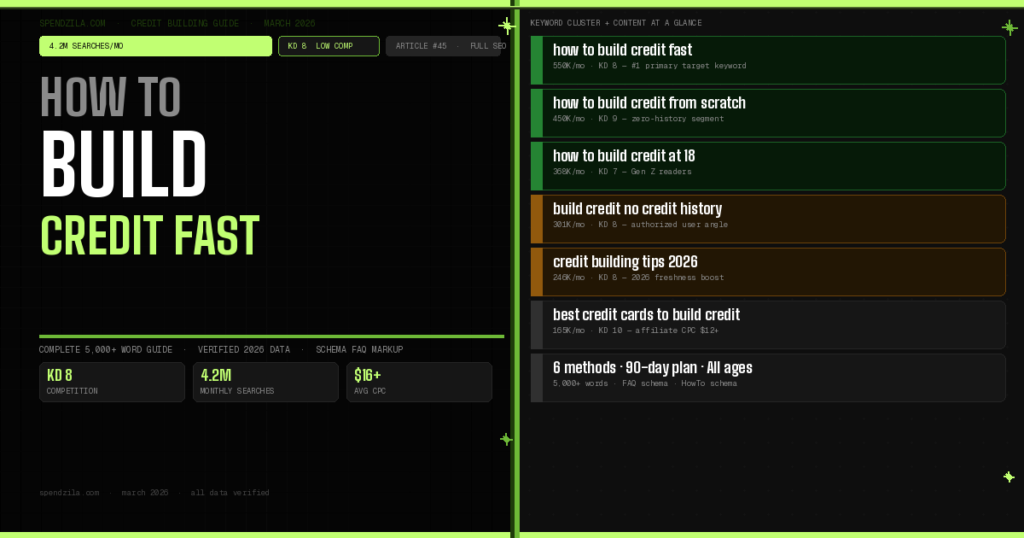
This guide covers every proven method to build credit in 2026, the fastest shortcuts, the best starter accounts, and a 90-day action plan you can start today.
Your FICO score — used in over 90% of lending decisions — is calculated from five factors with specific, publicly disclosed weightings. Build around these five factors and your score will follow predictably.
| Factor | Weight | What It Measures | How to Optimize |
|---|---|---|---|
| Payment History | 35% | Did you pay every bill on time? | Set autopay on every account — never miss a payment |
| Credit Utilization | 30% | Balance ÷ credit limit (lower = better) | Keep reported balance under 10% of your credit limit |
| Length of Credit History | 15% | Age of oldest account + average age of all accounts | Open accounts early, keep oldest accounts open forever |
| Credit Mix | 10% | Types of accounts (revolving + installment) | Have both a credit card AND a loan on your file |
| New Credit (Hard Inquiries) | 10% | How often you apply for new credit | Space applications at least 6 months apart |
The top two factors — payment history and utilization — control 65% of your score. Master those two above everything else.
Being added as an authorized user on someone else’s credit card is the fastest way to build credit history. When a family member or partner adds you to their account, their entire payment history on that card — often years of perfect payments — appears on your credit report within 30–60 days. You don’t need to use the card, receive the physical card, or even know the account number. The account simply appears on your report as if it were your own.
| Factor | Target | Why It Matters |
|---|---|---|
| Account age | 5+ years old | Older accounts boost your average account age (15% of score) |
| Payment history | 100% on-time | Any missed payment on their account also appears on yours |
| Utilization | Under 15% | Low balance = better combined utilization ratio in your file |
| Credit limit | $3,000+ | Higher limit dilutes your overall utilization ratio |
Issuers that report authorized users to all 3 bureaus: Discover, Chase, American Express, Capital One, Citi, Bank of America, Wells Fargo. Confirm before asking — some credit union cards and store cards report authorized users only to Equifax or don’t report at all.
Score impact: Most authorized users see a first credit score within 30–60 days of being added. If the primary account has 8+ years of perfect history, initial scores of 650–710 are common — a strong starting point that bypasses the 6-month waiting period entirely.
A secured credit card requires a refundable cash deposit ($200–$2,500 typically) that becomes your credit limit. It reports to all three credit bureaus every month — exactly like any regular credit card — building payment history and utilization data. When you close the account or upgrade to unsecured, your deposit is returned in full.
| Card | Min Deposit | Annual Fee | Rewards | Upgrade Path |
|---|---|---|---|---|
| 🥇 Discover it Secured | $200 | $0 | 2% gas/restaurants, 1% all else | Auto-review at 7 months |
| 🥈 Capital One Platinum Secured | $49–$200 | $0 | None | Auto-review at 6 months |
| Chime Credit Builder | $0 (no deposit!) | $0 | None | Requires Chime checking account |
| OpenSky Secured Visa | $200 | $35/year | None | No credit check to apply (best after bankruptcy) |
The optimal secured card usage strategy: Put one small, predictable recurring charge on the card — a $12/month streaming subscription works perfectly. Set autopay to “pay full statement balance” the day after the statement closes. This means your card reports a $0 balance to the bureau every month (0% utilization), while still generating monthly payment history. The card does its job — building your score — without any financial risk to you.
Experian Boost is a free service that scans your connected bank accounts for on-time payments you’re already making — and adds that positive history to your Experian credit file. The increase is immediate and reflected in your Experian score the same day.
Payments it adds to your file: electricity, gas, water, cell phone, internet, Netflix, Hulu, Disney+, Spotify, HBO Max, and rent (when paid through certain services). The average user gains +13 FICO points immediately. Users in the Poor score range (300–579) average +21 points.
Important nuance: Experian Boost only affects your Experian credit score, not Equifax or TransUnion. Mortgage lenders typically pull all three scores — so Boost helps one of three. For credit card applications and many personal loan applications (where lenders often check Experian specifically), this boost matters. Setup: experian.com/boost, takes 5 minutes, completely free.
Similar services: UltraFICO (also Experian, connects your bank account balance history), and Experian Go (helps credit-invisible people generate a first credit score).
A credit-builder loan is designed specifically for building payment history with no existing credit required. Unlike a normal loan, you don’t receive the money upfront. Instead, your monthly payments are held in a locked savings account, and you receive the full amount at the end of the loan term. Every payment is reported to all three credit bureaus.
| Provider | Monthly Payment | Term | You Receive at End | Bureaus |
|---|---|---|---|---|
| Self.inc | $25 – $150/mo | 12–24 months | $520 – $3,500+ | All 3 |
| Credit Strong | $28 – $199/mo | 12–120 months | $1,000 – $10,000 | All 3 |
| Local Credit Union | Varies | 12–24 months | Varies | Usually all 3 |
After 3 months of on-time Self.inc payments, Self offers a “Self Visa Secured Card” backed by a portion of your loan savings — giving you both installment credit (the loan) and revolving credit (the card) simultaneously. This satisfies the credit mix factor (10% of score) and accelerates your score growth significantly compared to card-only building.
If you’re in college, student credit cards are built for your exact situation. They require no credit history, work with low or no personal income (can include scholarships and parental support), and often have better rewards than secured cards.
| Card | Annual Fee | Rewards Rate | Best Feature |
|---|---|---|---|
| 🥇 Discover it Student Cash Back | $0 | 5% rotating categories, 1% all else | First-year rewards doubled (Cashback Match) |
| Capital One SavorOne Student | $0 | 3% dining, entertainment, streaming; 1% other | Best for students who dine out |
| Chase Freedom Student | $0 | 1% on all purchases | $20 Good Standing Reward each anniversary year |
Under the CARD Act, applicants under 21 need either a co-signer or independent income. Independent income can include: part-time job wages, work-study, student loan disbursements, scholarships, or regular financial support from parents — all count.
Rent is typically the largest monthly payment people make — yet it doesn’t appear on credit reports unless explicitly reported. Rent-reporting services forward your payment history to the credit bureaus, giving your score credit for a bill you’re already paying reliably.
| Service | Cost | Bureaus Reported | Back-Reporting Available |
|---|---|---|---|
| Boom (CreditMyRent) | $2–$5/month | All 3 bureaus | Yes — up to 24 months free |
| Rent Reporters | $9.95/month | TransUnion + Equifax | Yes — up to 24 months ($25 fee) |
| Experian RentBureau | Free (via landlord) | Experian only | No |
WEEK 2 — Set up for success
☐ Activate new card — set ONE recurring charge ($10–$20 streaming service)
☐ Set autopay to “FULL statement balance” — never remove this setting
☐ Enroll in Self.inc credit-builder loan $25/month plan
☐ Set up rent reporting via Boom if you pay rent
MONTH 2–3 — Monitor and maintain
☐ Confirm all accounts reporting to all 3 bureaus via free Credit Karma
☐ Check utilization before each statement close — keep under 10%
☐ Self.inc payment processes automatically — confirm first payment cleared
☐ Your first credit score should appear by end of month 2
MONTH 6 — Milestone review
☐ Check score — target: 620–660 at 6 months with authorized user
☐ If Discover it Secured: Discover auto-reviews at 7 months for upgrade
☐ Consider applying for one no-annual-fee unsecured card if score 640+
MONTH 12 — Target score: 700–730
☐ Apply for a rewards credit card to diversify your account types
☐ Your credit history is now 1 year old — significant score boost incoming
☐ Keep oldest accounts open permanently to protect account age
| Timeframe | Expected Score Range | What Opens Up |
|---|---|---|
| Month 0 | No score (credit invisible) | Secured card · Self.inc · Authorized user |
| Month 1–3 | 580–640 (Fair) | Most student cards · Some personal loans |
| Month 6–9 | 640–680 (Fair–Good border) | Unsecured credit cards · Apartment rentals |
| Month 12–18 | 700–730 (Good) | Auto loans · Most credit cards · Good rates |
| Month 24–36 | 740–780 (Very Good) | Best mortgage rates · Premium rewards cards |
1. Closing your secured card after upgrading. Keep secured cards open or ask the issuer to upgrade to an unsecured version of the same product. Closing the account eliminates its history and reduces your available credit — both hurt your score.
2. Applying for too many cards at once. Each application is a hard inquiry that temporarily drops your score 2–10 points. Space applications at least 6 months apart. Applying for 3 cards in a month signals credit-seeking behavior to lenders.
3. Carrying a balance to “build credit.” A persistent myth. Carrying a balance costs you 22%+ APR and does nothing for your score. Pay in full every month — always. Only the existence of the account and your payment history matter, not whether you carry a balance.
4. Missing even one payment. One 30-day late payment can drop your score 60–110 points and stays on your report for 7 years. Set autopay on every account — minimum payment as a failsafe at minimum.
5. Maxing out your credit limit. Utilization above 30% hurts your score noticeably. Above 50% hurts significantly. Above 90% (near-maxed) can drop scores 50–100 points. Even if you pay in full, the utilization on your statement date gets reported — pay before the statement closing date to report $0.
6. Not disputing errors. The FTC found 1 in 5 credit reports contains an error. Common errors: accounts not yours, late payments listed incorrectly, accounts shown as open after being closed. Check all three reports annually at AnnualCreditReport.com. Dispute online at Equifax.com, Experian.com, or TransUnion.com — free, results required within 30 days.
7. Getting store credit cards at checkout. Store cards have the lowest limits ($200–$500), the highest APRs (25–29%), and the least credit-building benefit. Say no to checkout card pitches unless you spend thousands per year at that specific store.
📈 Start Building Your Credit Score Today
Pick your starting point, open the right account, and your score will follow.
Related: What Is a Good Credit Score? · Average US Credit Score 2026 · Applying for First Credit Card · Best Starter Credit Cards · Types of Credit Cards
Manage your cookie preferences below. Essential cookies are required for the site to work. Your financial calculator data is never stored in cookies.
Necessary for basic site functionality — navigation and forms. Cannot be disabled.
Google Analytics (anonymized) — helps us understand how visitors use the site. No personal data collected.
Google AdSense — used to show relevant ads. Helps keep Spendzila free for everyone.
Remember your last-used tool or tab for a better experience. No financial data stored.



Be the first to leave a comment!
Leave a Comment